December 15, 2025
Cognitive Offsetting: Decision Dominance and the Battle for Mental Bandwidth
The U.S. Armed Forces and our Allies are experiencing a crisis in cognitive capacity. Decision Dominance is the solution.
The modern battlefield is no longer simply geographical. It’s increasingly defined by the contest for cognitive bandwidth — and U.S. adversaries are weaponizing information overload.
The CCP's military modernization strategy explicitly targets our decision-making processes through what’s known as “systems confrontation and systems destruction.” The goal isn’t just to defeat our platforms, but rather to collapse our ability to observe, decide, and act coherently across domains.
When cognitive bandwidth becomes overloaded, the brain defaults to survival logic. That means compounding errors, slowed decisions, and the loss of strategic reasoning. Victory in such a scenario goes to whoever can think clearly under pressure, correctly analyze relevant multimodal data, and make the right decisions in real time.
A Crisis in Cognitive Capacity
Today’s operational reality puts commanders and staffs in an impossible position.
Sensor proliferation, ISR feeds, and the demands of battle rhythm decision making routinely outpace human cognitive bandwidth. When this happens, decision makers are forced to fall back on heuristics, default plans, or incomplete understanding. The reality is, more data doesn't result in better decisions—it results in increased cognitive burden and confusion.
Adding to this complexity are strategic efforts by our adversaries to actively render our operational systems ineffective. This is accomplished in a number of ways, including flooding command and control pipelines with disinformation, compressing escalations cycles, and using electromagnetic disruption to hinder our ability to respond effectively.
For the U.S. and our Allies, this reveals a fundamental vulnerability: the fragile dependence on human cognitive throughput. Our kill chains, decision cycles, and operational frameworks all rely on the human system to function coherently. Adversaries understand this and are actively building to exploit it.
There are warning signs across the Joint Force: mental saturation during high-tempo operations, slowed or missed critical decisions, uneven workload distribution, reliance on heuristics, and limited live visibility into cognitive load or fatigue levels.
This isn't just about tactical inefficiency—it's about strategic miscalculations waiting to happen.
Using Deep-RL and AI to Offset Cognitive Overload
To solve this problem, we need to reimagine how humans and machines work together and treat cognitive load like fuel or ammunition—something to be managed and distributed deliberately.
This is where Decision Dominance comes in: the ability to analyze and contextualize vast streams of structured and unstructured data—including sensor data—to make the right decisions across the kill chain faster, more accurately, and more effectively than our adversaries.
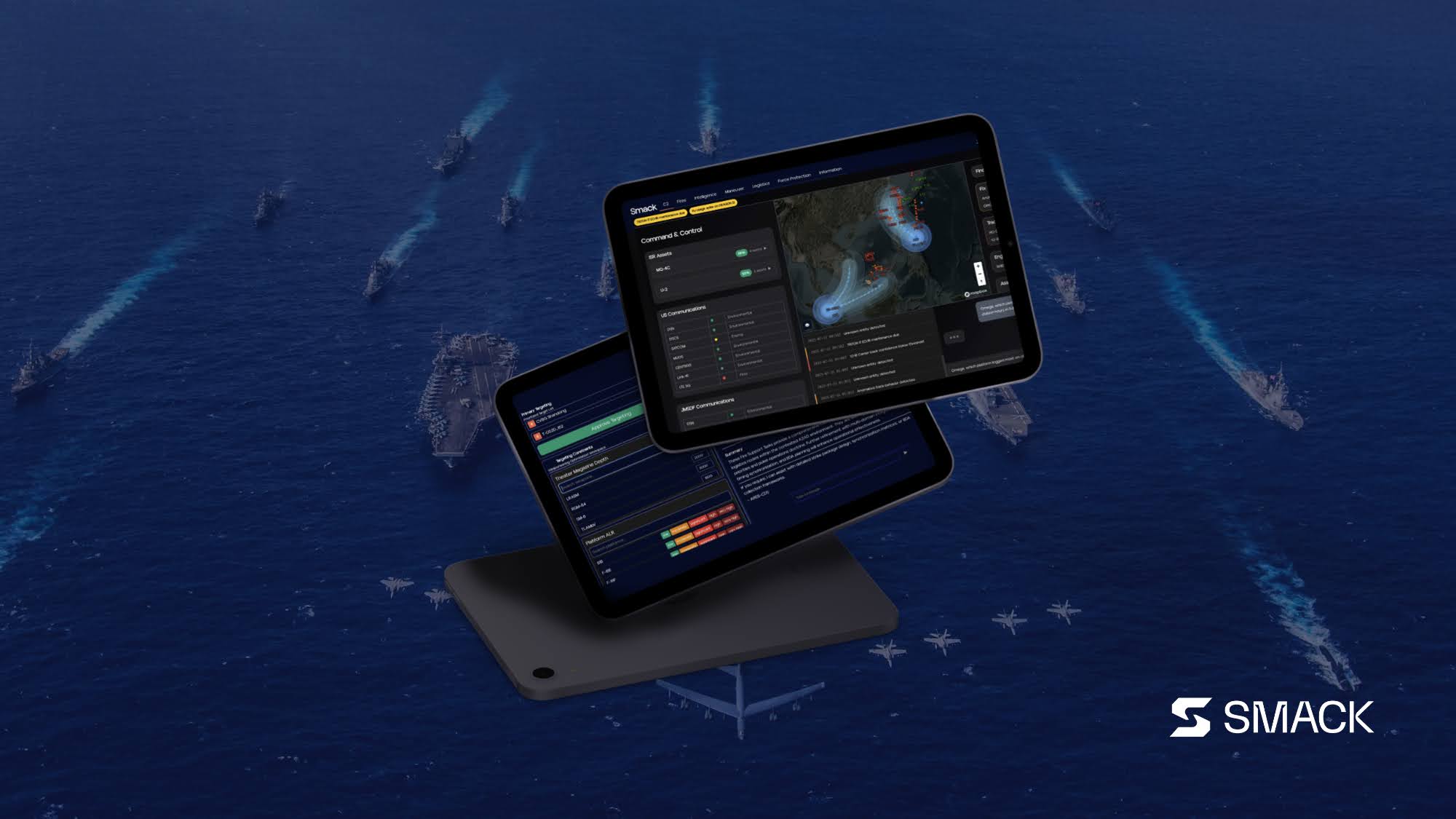
To achieve this, Smack has developed the “Brain for the Kill Chain”: an agent-based learning and reasoning platform that leverages bleeding edge Deep Reinforcement Learning algorithms built specifically for modern warfare. Our technology rapidly fuses and analyzes multimodal sensor data using a combination of proprietary deep-RL models and computational vision, teaching thousands of reinforced agents how to learn and reason in a coordinated way.
This technology fundamentally shifts the cognitive burden from humans to machines. AI handles the data processing and pattern recognition, and commanders receive curated, trustworthy information that's been pre-filtered, analyzed, and ranked by success probability and risk factors.
The result is cognitive offset at scale. Instead of managing information overload and drowning in sensor feeds, humans are managing informed choices and seeing actionable COAs that factor in weather, telemetry, unknown targets, and adversary adaptations in real-time.
The Implementation Imperative
Beyond just the technology, success in offsetting cognitive overload will require cultural adaptation, acquisition reform, and cross-sector collaboration. The Department of War must transition from manpower-limited staff models to AI-augmented decision ecosystems that operate at machine speed while preserving human judgment.
This means embedding decision-support logic and real-time workload sensing at the tactical edge, using reinforcement learning to forecast adversary adaptations and refine course-of-action recommendations, and providing commanders with cognitive strain heat maps to proactively redistribute workload across echelons.
Equally critical is coalition cognitive interoperability. We must establish standards that allow trusted, real-time coordination with allies and partners who will account for 40-60% of necessary resources in any future conflict.
Decision Dominance belongs to the side that thinks faster, with clarity, under pressure. In an age where adversaries are actively targeting our cognitive processes, protecting the mental bandwidth of commanders and staffs isn't just a force multiplier — it's an existential requirement.